ResearchThree areas
Studying what cannot always be observed directly.
Simulate
Turn a biological mechanism into equations or agents, then run it.
Test the mechanisms
Vary a parameter, a behavioural rule or a release scenario, and watch what changes.
Interpret
Relate the results back to biology, and state their conditions of validity and their limits.
A
Population dynamics and biocontrol
The doctoral work. Under what conditions do releases of sterile males reduce a pest population, when sterilisation is imperfect (residual fertility), when females mate several times (polyandry), or when releases are periodic and limited by a budget?
Methods: Differential equations · Bifurcation analysis · Impulsive models · Individual-based models
- Python
- SciPy
- SymPy
- python-control
- Mesa
- NumPy
- pandas
- statsmodels
- seaborn
Publications
Projects
12 talks and posters
- Exploring the re-mating and sperm utilization biases in Drosophila suzukii: an agent-based model(opens in a new tab)
- Sterility in Trouble: When Pest Love Life Challenges Sterile Insect Technique Success(opens in a new tab)
- Sterility on the rocks: when pest love life challenges sterile insect technique success(opens in a new tab)
- Analyse de l'impact du ré-accouplement et des biais d'utilisation du sperme chez Drosophila suzukii : élaboration d'un modèle individu-centré(opens in a new tab)
- Sterile Insect Technique: accounting for residual fertility(opens in a new tab)
- Sterility on the rocks(opens in a new tab)
- Multiple mating: a threat?(opens in a new tab)
- Re-mating consequences on the efficiency of the sterile insect technique(opens in a new tab)
- How does residual fertility impact the effectiveness of the sterile insect technique in controlling Ceratitis capitata?(opens in a new tab)
- Sterile Insect Technique for crop protection: accounting for residual fertility(opens in a new tab)
- Sterile insect technique for crop protection: accounting for residual fertility(opens in a new tab)
- Sterile insect technique against the medfly: modelling, calibration and effect of residual fertility(opens in a new tab)
B
Invasiveness of a species and its functional response
Do invasive species consume more prey than other species, and does that measure predict their impact? A statistical analysis of functional responses already published for 45 freshwater fish species, carried out with Chloé Souques, Yann Voituron, Loïc Teulier, François-Xavier Dechaume-Moncharmont (LEHNA, Université Claude Bernard Lyon 1) and Vincent Médoc (ENES, Saint-Étienne).
Methods: Comparative analysis of published data · Bayesian mixed models (MCMCglmm) · Phylogenetic correction
- R
CIn progress
Integrating multi-omics data to study plant responses to multiple stresses
Work in progress. How does tomato respond to a stress that combines heat and salinity? Transcriptomic and metabolomic data are integrated with deep learning models, including a variational autoencoder (VAE), built with PyTorch. No result has been published yet.
Models and tools
- Deep learning
- Variational autoencoder (VAE)
- Transcriptomics
- Metabolomics
- PyTorch
- Python
No publication or result yet: this work is in progress.
The work in figures.
Area A
The sterile insect technique
Releasing sterilised males to disrupt the reproduction of a pest.
The sterile insect technique relies on releasing sterilised individuals to reduce the reproduction of a target population. How well it works depends on many biological and technical factors, whose effects can be explored with models.
Read the detail: The sterile insect technique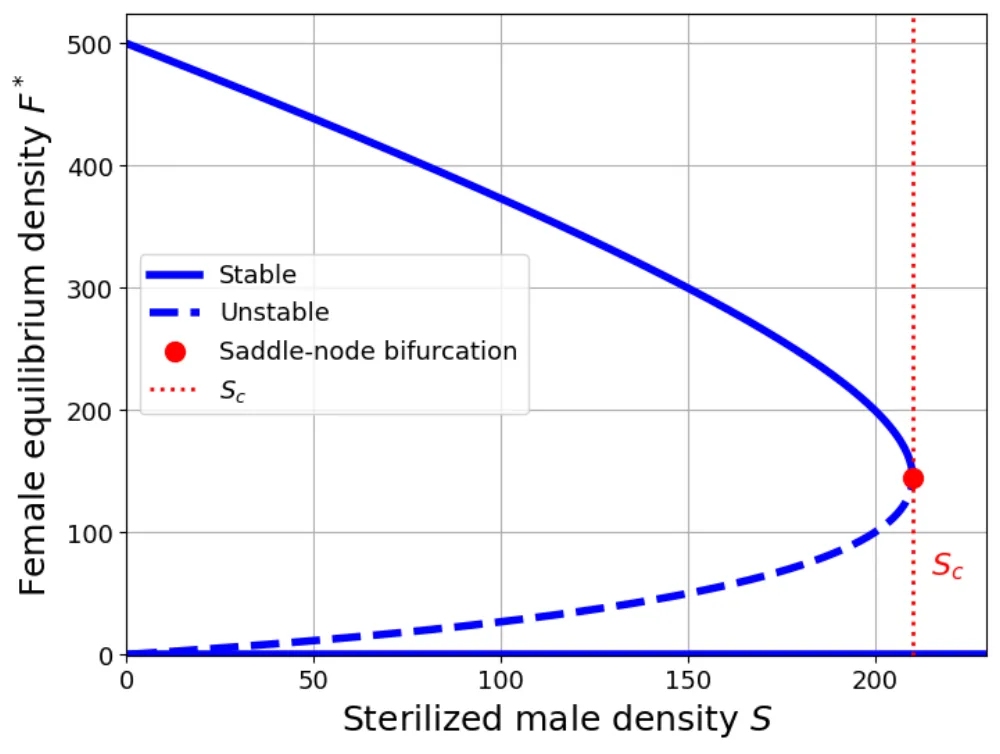
Thesis figure — fig_chapter2_thesis.ipynb Area A
Residual fertility
When sterilisation is imperfect.
Sterilisation can be imperfect. Residual fertility in the released insects can change the outcome of control strategies. This work examines when these effects become decisive.
Read the detail: Residual fertility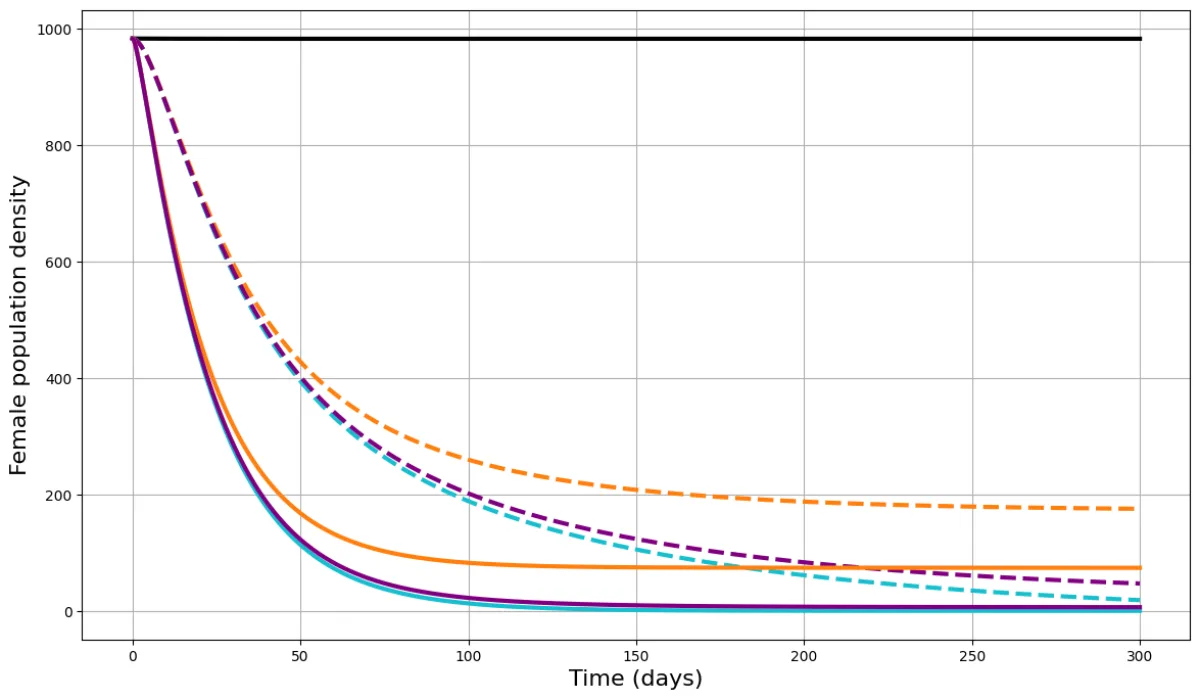
Thesis figure — Script_Manuscrit_SIT_RF.ipynb Area A
Multiple matings
Polyandry, re-mating and sperm use.
In some species, females can mate several times. Re-mating and the way sperm is used can then influence how well sterile insect releases work.
Read the detail: Multiple matings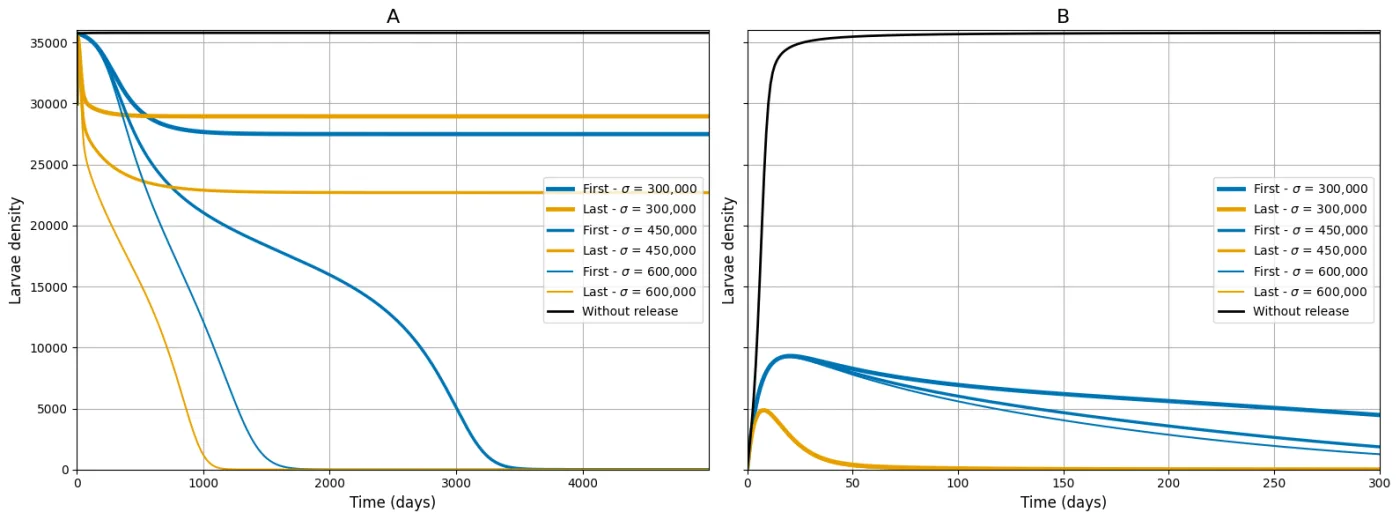
Thesis figure — Compartmental_model_output_vAvril.ipynb Area A
Individual-based modelling
Representing each insect, its behaviour and its interactions.
Individual-based models represent each organism, its age, its matings and its egg laying. They can include individual variability and behavioural rules that are hard to express in an aggregated model.
Read the detail: Individual-based modelling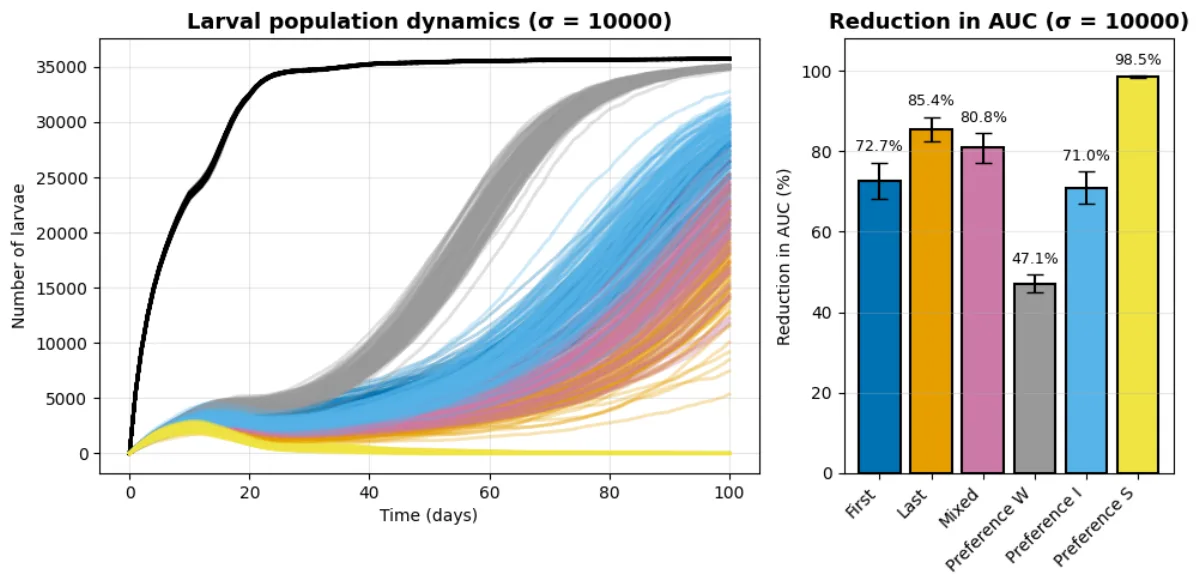
Thesis figure — ABM_model_output.ipynb Area A
Release strategies and deployment constraints
Frequency, size and a limited budget.
In practice, sterile males are released at discrete times, with a limited budget. The thesis chapter on the agricultural context studies how to split that budget between the frequency and the size of releases.
Read the detail: Release strategies and deployment constraints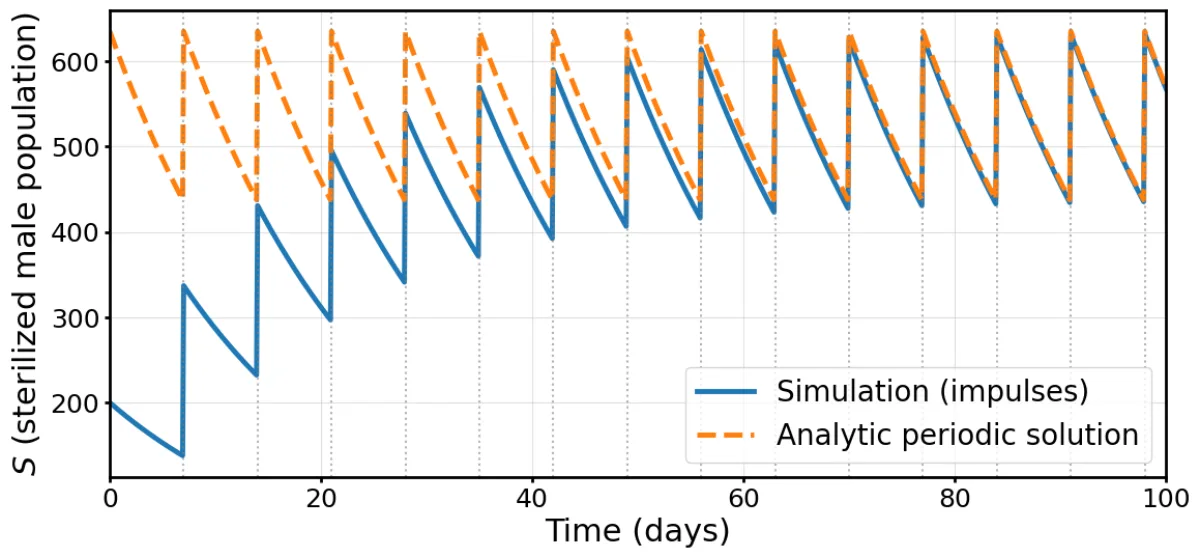
Thesis figure — Notebook_part_impulsive_releases.ipynb Area B
Invasion ecology
Functional responses, invasiveness and trophic impact.
Studying functional responses helps understand how resource consumption, species traits and the ability to become invasive are linked. The geographical and ecological context can change how these links are read.
Read the detail: Invasion ecology