Aim
Follow each insect one by one (its lifespan, its matings, the sperm it stores, its egg laying) to see how these individual behaviours decide, at the scale of the population, whether sterile male releases succeed.
Scientific value
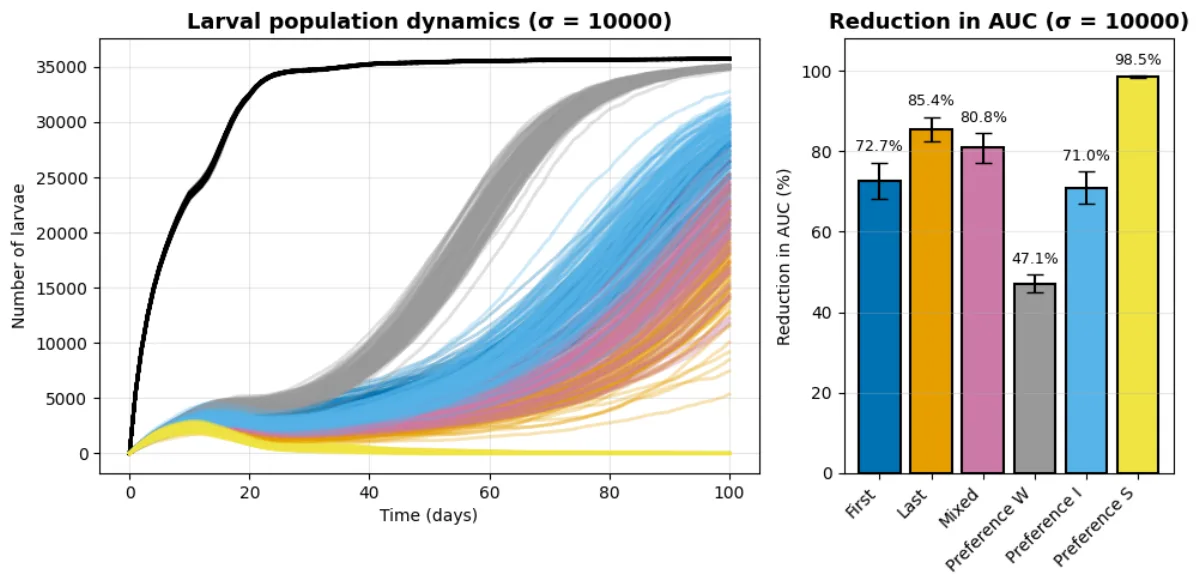
An equation model describes average numbers: it cannot tell what each female's spermatheca contains. The individual-based model can. It compares five sperm-use rules (first male, last male, mixed, choice, preference) where the compartmental model distinguishes two, and it accounts for chance: each scenario is run 100 times.
Context
The sterile insect technique relies on mass releases of sterilised males. In many species, Drosophila suzukii among them, females mate several times, and the mechanisms that govern how stored sperm is used remain poorly known.
Question
Whether a female preferentially uses the first or the last sperm received, fertile or sterile sperm, or a mixture, does the efficiency of the releases change?
Results shown
- In the long term, multiple mating is unfavourable: it requires more sterile male releases to control the population.
- In the short term, it can be beneficial by “defertilising” females already mated with wild males.
- The influence of sperm-use biases remains limited, depending on the release effort that can be deployed.
Limitations
- The model is calibrated on a single species, Drosophila suzukii.
- Sperm-use mechanisms are still poorly known: the scenarios bracket what is possible rather than settle it.
- The demonstrator on this site is scaled down fiftyfold and illustrates how the model works; it does not replace the published simulations.
Next steps
- An interactive application to explore the model's scenarios is in development (information supplied by Marine Courtois).
See the model at work
Sperm-use rule
Equivalent to 10,000 individuals per day at the scale of the original model.
Individual scale — females and the content of their spermatheca
Day 0: .
- fertile
- fertile + sterile
- sterile
- unmated
Population scale
- Larvae
- Females
- Wild males
Figures and media