In brief
Sterilisation sometimes leaves part of the released males still fertile. The study measures what this residual fertility changes for the sterile insect technique: the models separate the situations where the pest population can be eliminated from those where it is only reduced.
Question
If a small fraction of the released males stays fertile, can the sterile insect technique still eliminate a pest population?
Approach
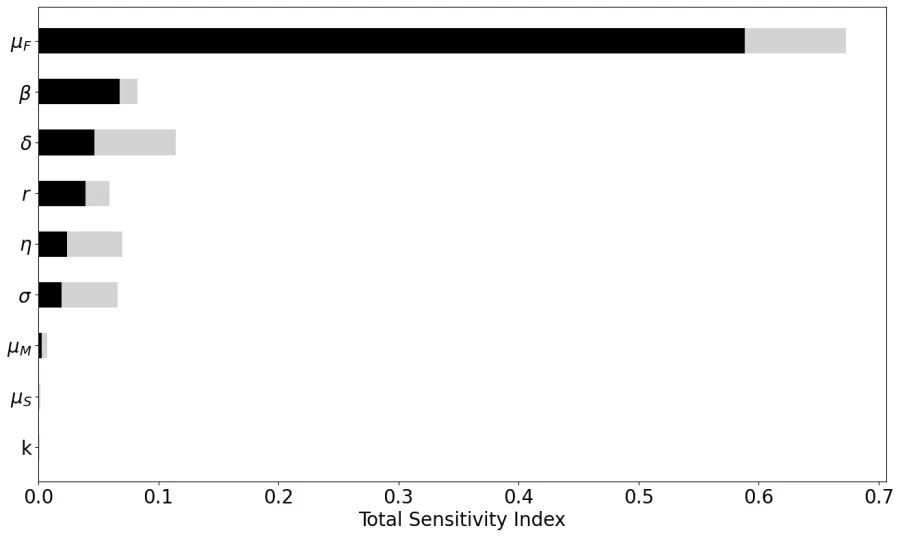
A model of three differential equations (sterile males, wild females and wild males), studied mathematically (equilibria and tipping thresholds, or bifurcations) and by simulation, with a sensitivity analysis of the parameters.
Research area
Cite
Courtois, M. A., Mailleret, L., Touzeau, S., van Oudenhove, L., & Grognard, F. (2025). How Residual Fertility Impacts the Efficiency of Crop Pest Control by the Sterile Insect Technique. Bulletin of Mathematical Biology, 87(2), 25. https://doi.org/10.1007/s11538-024-01401-1
Show the BibTeX entry
@article{courtois2025residual,
  title = {{How Residual Fertility Impacts the Efficiency of Crop Pest Control by the Sterile Insect Technique}},
  author = {Courtois, Marine A. and Mailleret, Ludovic and Touzeau, Suzanne and van Oudenhove, Louise and Grognard, Frédéric},
  journal = {Bulletin of Mathematical Biology},
  year = {2025},
  volume = {87},
  number = {2},
  pages = {25},
  doi = {10.1007/s11538-024-01401-1},
  url = {https://doi.org/10.1007/s11538-024-01401-1}
}Discover
Why can releasing sterile insects protect a crop?
The pest insect is mass-reared, the males are sterilised and then released. A female that mates with a sterile male has no offspring: the more sterile males there are, the less the population renews itself, and it can decline.
Understand
What if some of the males stayed fertile?
Sterilisation is done by irradiation, and it is not perfect: a proportion of males escape it. This is residual fertility. These males, released with the others, produce offspring.
Irradiation can also weaken the males, which biologists call a fitness cost. The article compares these situations with that of flawless sterilisation.
Observethe mechanism
Sterilisation is not always perfect. This model follows three populations (sterile males S, wild females F and wild males M) and distinguishes two forms of residual fertility.
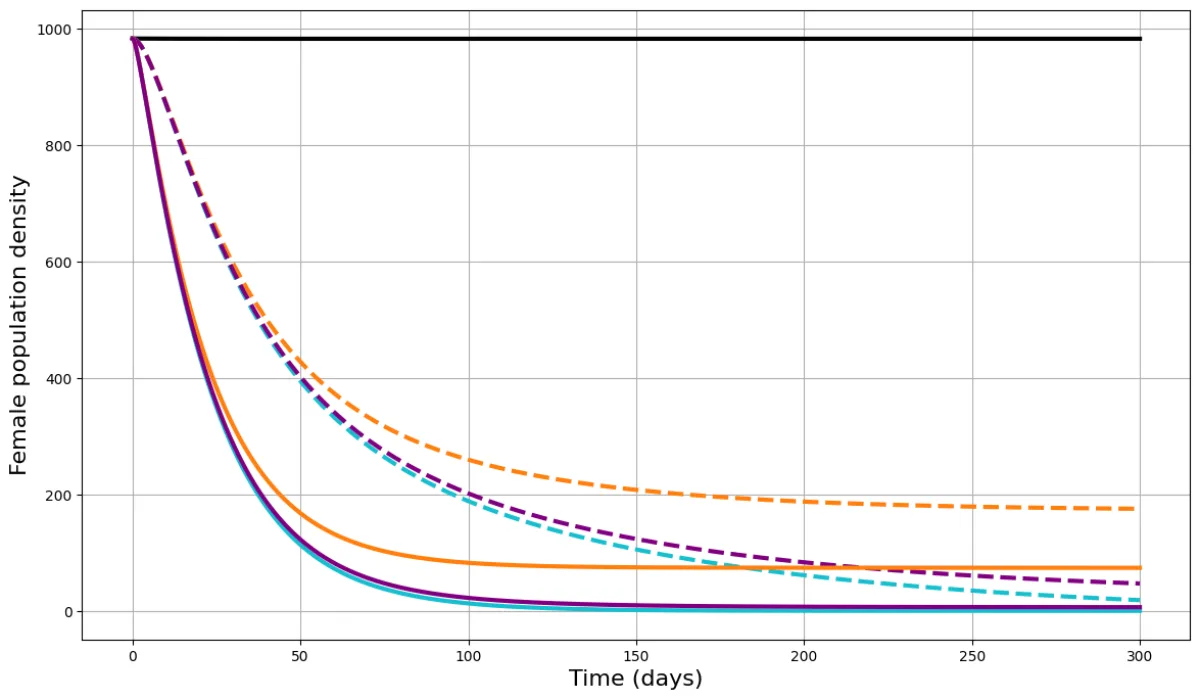
δ: share of released males that remain fully fertile. ε: share of matings with a sterile male that remain fertile.
Explorethe parameters
- No releases
- Releases, perfect sterility
- Releases with residual fertility
Understandthe results
At t = 300 days, the model gives 18.3 females with perfect sterility and 175.2 with residual fertility, against 983 without releases.
Raise δ: even with intense releases, the solid blue curve can settle above zero, a reduction rather than a suppression.
Courtois, Mailleret, Touzeau, van Oudenhove & Grognard (2025). Bulletin of Mathematical Biology 87, 25.
- PublicationBulletin of Mathematical Biology, 2025
- DOI10.1007/s11538-024-01401-1(new tab)
- CodeScript_Manuscrit_SIT_RF.ipynb — thesisData(new tab)
- MethodologyResearch theme: residual fertility
TypeScript port (RK4, step 0.1 day) of the notebook's modele_SIT function, with its fixed parameters and the initial condition F₀ = M₀ = 983. Checked: reproduces the notebook's “time dynamics” figure (σ = 500 and 5,000). Teaching exploration: it does not replace the published analyses.
Go deeper
Model, assumptions, results and limits.
Three differential equations describe how sterilised males, wild males and wild females change over time. The equilibrium states of the population and their stability are calculated exactly. To locate the thresholds (bifurcation analyses), the parameters are those of the Mediterranean fruit fly, Ceratitis capitata.
Assumptions
- A proportion of irradiated males escape sterilisation (residual fertility).
- This residual fertility is studied with or without a fitness cost linked to sterilisation.
- Reference: flawless sterilisation of the males.
Published results
- Below a residual fertility threshold, flooding the landscape with sterilised males can drive the wild population to extinction.
- This threshold is higher when residual fertility comes with fitness costs.
- Too much residual fertility makes the sterile insect technique less effective and prevents eradication.
- The pest population can still be strongly reduced for much higher residual fertility rates.
Limits
- The thresholds come from parameters calibrated on Ceratitis capitata: they depend on the species.
- These are model results, not field trials.