PhD
Three years to understand the limits of a biological control strategy.
Doctoral research on the sterile insect technique and the biological and technical factors that affect its effectiveness.
PhD — Université Côte d'Azur — Defended: 27 November 2025
Modeling the Sterile Insect Technique in an agricultural context: examining biological and technical factors likely to reduce its effectiveness
Official title (French)
Modélisation de la technique de l'insecte stérile dans un contexte agricole : examen des facteurs biologiques et techniques susceptibles d'atténuer son efficacité
Chapter 3
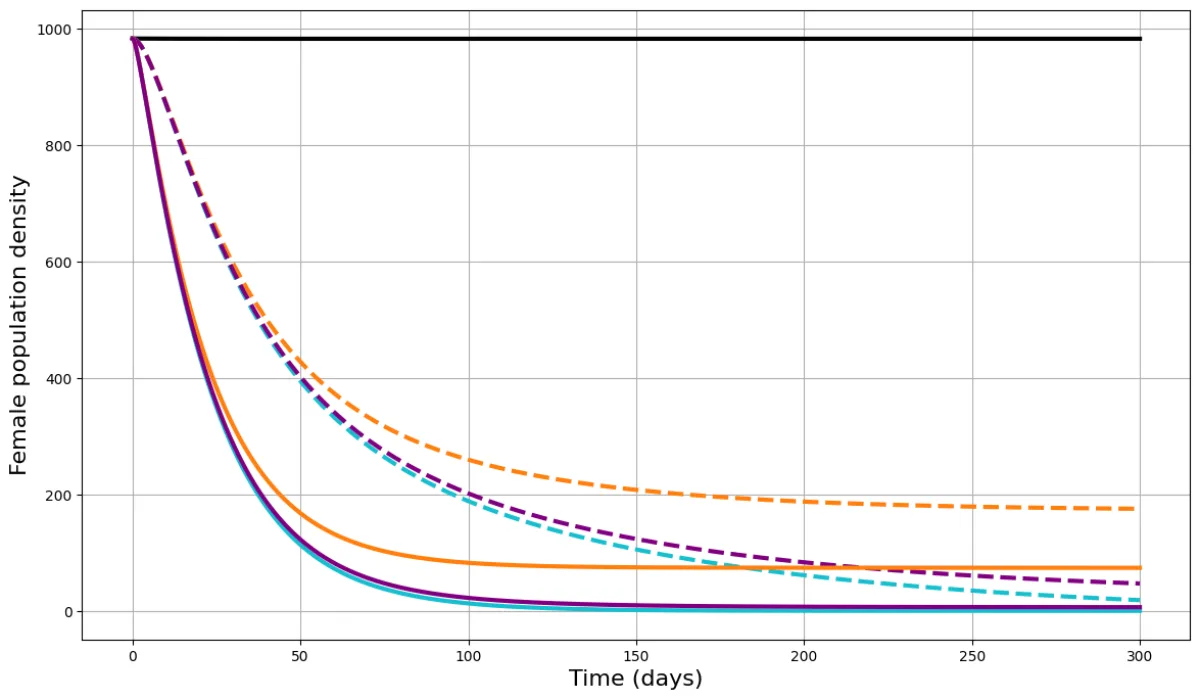
Despite sterilisation, some males keep a low level of fertility. What are the consequences for control?
- Method
- A differential-equation model, bifurcation curves, time dynamics and sensitivity analysis.
- Key concept
- Cost-free (δ) and costly (ε) residual fertility: two mechanisms, two effects.
- In simple terms
- If a small share of the released males stays fertile, the population can, under some conditions, be strongly reduced without being eliminated.
The question
How can biological behaviours and technical constraints change the effectiveness of a biological control strategy?
My thesis addresses this question in the setting of the sterile insect technique. It explores the consequences of imperfect sterilisation, the effects of re-mating and the ways releases are carried out, through several modelling approaches.
- Scientific context
- The sterile insect technique, a biological control strategy that aims to reduce pest populations by disrupting their reproduction.
- Biological mechanisms
- Residual fertility of released males, multiple mating by females and sperm-use rules.
- Technical constraints
- Discrete releases, limited budget, trade-off between frequency and intensity, fruit quality.
- Mathematical approach
- Ordinary differential equations, analysis of equilibria and bifurcations, impulsive models.
- Computational approach
- Individual-based model in Python (Mesa), repeated simulations, sensitivity analysis, reproducible notebooks.
Publications from the thesis