In brief
In Drosophila suzukii, a female can mate with several males and keep their sperm. Using a mathematical model and simulations that represent every insect, the study shows that these multiple matings do not affect the sterile insect technique in the same way in the short term and in the long term.
Question
When the females of a pest mate several times, can the way they use stored sperm change the outcome of sterile male releases?
Approach
A compartmental model (differential equations) and an individual-based model written in Python with the Mesa library, comparing several sperm-use rules: first male, last male, mixing, choice and preference.
Research area
Cite
Courtois, M. A., van Oudenhove, L., Touzeau, S., Grognard, F., & Mailleret, L. (2026). Polyandry: A threat or an opportunity for the sterile insect technique?. PLOS Computational Biology, 22(4), e1014212. https://doi.org/10.1371/journal.pcbi.1014212
Show the BibTeX entry
@article{courtois2026polyandry,
  title = {{Polyandry: A threat or an opportunity for the sterile insect technique?}},
  author = {Courtois, Marine A. and van Oudenhove, Louise and Touzeau, Suzanne and Grognard, Frédéric and Mailleret, Ludovic},
  journal = {PLOS Computational Biology},
  year = {2026},
  volume = {22},
  number = {4},
  pages = {e1014212},
  doi = {10.1371/journal.pcbi.1014212},
  url = {https://doi.org/10.1371/journal.pcbi.1014212}
}Discover
Can a female that mates several times defeat biological control?
In many insects, females mate with several males and store their sperm. A female mated with a sterile male can therefore still reproduce thanks to a wild male, and the reverse is also true.
Understand
It all depends on how the sperm is used.
After several matings, which sperm fertilises the eggs? The first received, the last, preferably the fertile, preferably the sterile, or a mix? These mechanisms are still poorly known.
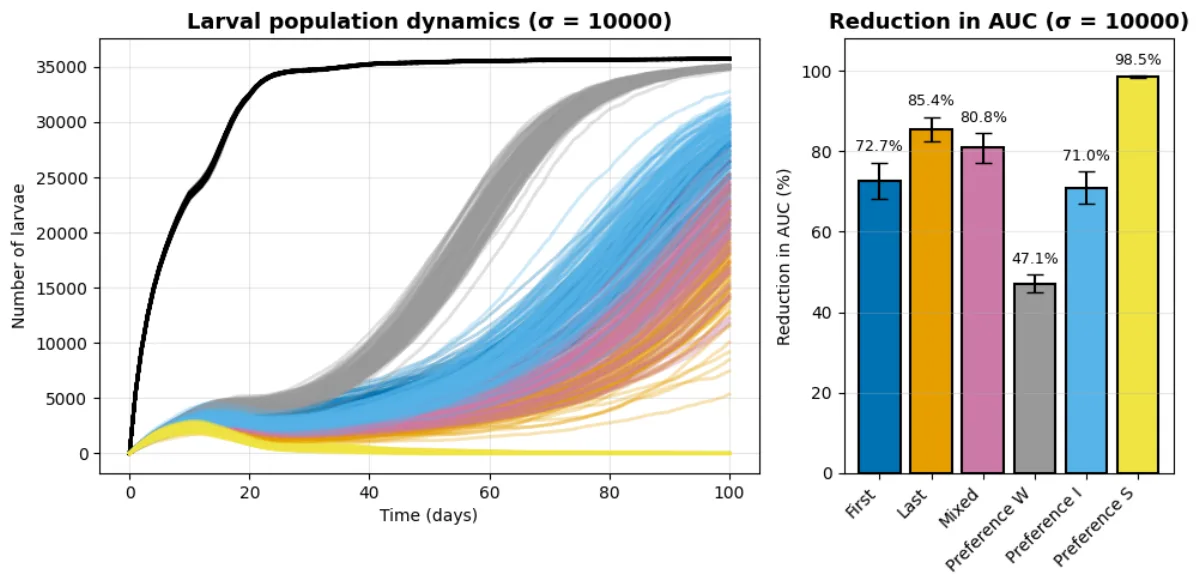
A first model, called compartmental, follows average numbers (how many larvae, males, females): it measures the overall effect of multiple matings. A second, individual-based, follows each female and the sperm she has stored: it compares the ways that sperm can be used.
Sperm-use rule
Equivalent to 10,000 individuals per day at the scale of the original model.
Individual scale — females and the content of their spermatheca
Day 0: .
- fertile
- fertile + sterile
- sterile
- unmated
Population scale
- Larvae
- Females
- Wild males
Go deeper
Model, assumptions, results and limits.
A compartmental model based on differential equations measures the overall effect of multiple matings. An individual-based model, calibrated on Drosophila suzukii, compares several ways of using sperm: priority to the first or the last male, to fertile or sterile sperm, or a mix of both.
Assumptions
- Females can mate several times and store the sperm of several males.
- Several sperm-use rules are explored as scenarios, since no mechanism is established.
- Biological parameters of the individual-based model calibrated on Drosophila suzukii.
Published results
- In the long term, multiple matings are a drawback: more releases of sterilised males are needed to control the population.
- In the short term, they can help by “defertilising” females already mated with wild males.
- Depending on the release effort that can be deployed, the way sperm is used may have only a limited influence.
Limits
- Sperm-use mechanisms remain poorly known: the scenarios cover several possibilities without deciding between them.
- The individual-based model is calibrated on a single species.
Observethe mechanism
In Drosophila suzukii, females can mate several times. The model separates females fertilised by a fertile male (FF) or a sterile one (FI); remating moves them from one state to the other.
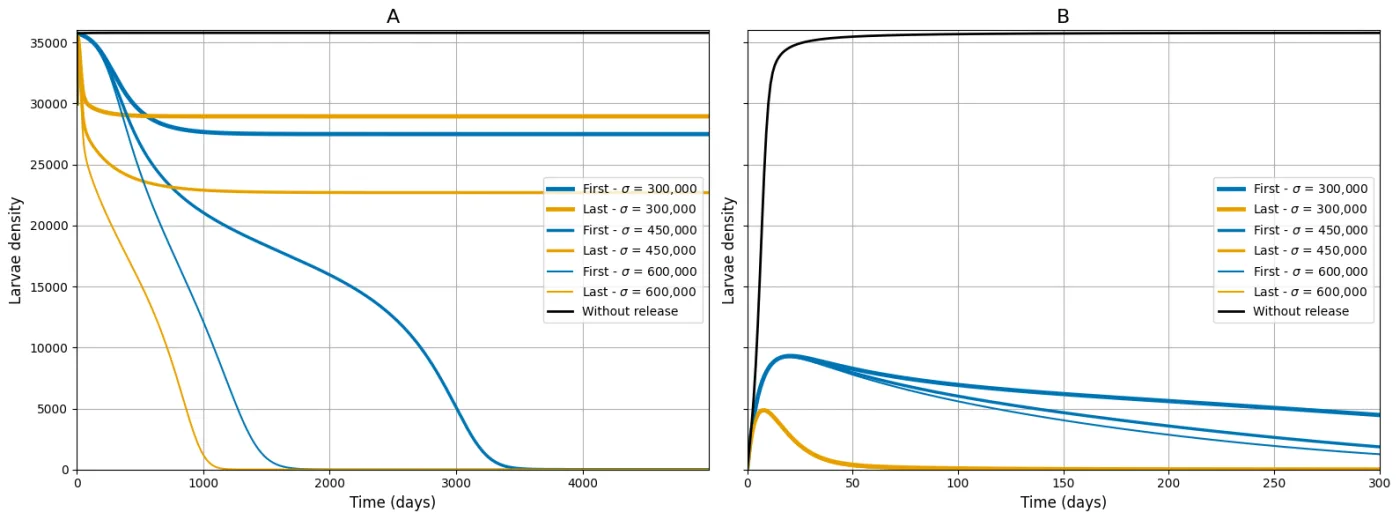
“First”: only the first mating counts (τ = 0). “Last”: the last mating determines the offspring (τF = 0.12; τI = 0.14 per day).
Explorethe parameters
Initial infestation
- No releases
- “First” — first male
- “Last” — last male
Understandthe results
At the end of the simulation: 0 larvae (“First”) and 22,693 (“Last”).
Compare the two horizons: depending on the release intensity, the rule that brings the population down fastest at first is not necessarily the one that eliminates it in the long term.
Courtois, van Oudenhove, Touzeau, Grognard & Mailleret (2026). PLOS Computational Biology 22(4): e1014212.
- PublicationPLOS Computational Biology, 2026
- DOI10.1371/journal.pcbi.1014212(new tab)
- CodeCompartmental_model_output_vAvril.ipynb — thesisData(new tab)
- MethodologyResearch theme: multiple mating
TypeScript port (RK4, step 0.05 day) of the notebook's modele_SIT system, with the notebook's parameters (μL = 0.037; K = 36,000; η = 0.6…). Checked: reproduces panels A and B of the First/Last figure for σ = 300,000, 450,000 and 600,000. Teaching exploration: it does not replace the published analyses.